
T.R. Reid's latest article on health care reform, in the Washington Post:
Universal health care tends to cut the abortion rate
Showing posts with label health care. Show all posts
Showing posts with label health care. Show all posts
Sunday, March 14, 2010

Monday, December 21, 2009
So what will your legacy be?*
On the day before the presidential inauguration, I saved a quote from an article by Tony Rhodin, an editor for a local Pennsylvania newspaper (The Express-Times Daily). What he wrote was surprisingly simple, but true:
Obama's early legacy will be based on his actions, not his rhetoric. He has a huge majority in Congress and has huge public support. He is positioned to do great good. The real question is if he can.**
I think it was Gandhi who said that action expresses priorities. If the Senate is ultimately successful in passing the health care reform bill this week, then we'll not only have concrete proof of our government's political priorities, but also a poignant preview of the presidential legacy that Obama is poised to leave behind.***
*Lyrics from Wakey Wakey's "War Sweater".
**Rhodin, Tony. "Barack Obama's legacy will be one of action -- or lack thereof." LeHigh Valley Express-Times. 19 Jan 2009.
***Read more about the current developments & some of the basic reforms included in the health care bill here, on the NY Times: "Health Bill Passes Key Test in the Senate with 60 Votes".
Saturday, November 21, 2009
"...I just want to say that I believe there are options out there! A take a number option, like they have in a deli."*
From The Wall Street Journal | Health
The Henry Ford of Heart Surgery
In India, a Factory Model for Hospitals Is Cutting Costs and Yielding Profits
One of the best quotes?
The Henry Ford of Heart Surgery
In India, a Factory Model for Hospitals Is Cutting Costs and Yielding Profits
One of the best quotes?
"What health care needs is process innovation, not product innovation."
- Dr. Devi Shetty

- Dr. Devi Shetty
Also, Holy Taco (in East Atlanta) is my new favorite restaurant option for Mexican food. Much better than standing in a deli line for a chicken quesadilla...
*Quote from the latest episode of The Office. Don't know how many options there will be for health insurance if the vote for the recent bill doesn't go through, though...
Sunday, November 8, 2009
H.R. 3962, in the House.
Recent weekend developments worth mentioning
And in health care reform:
- Obama Calls Health Care Bill's Passage 'Courageous' (NY Times)
- Is the House Health Care Bill Better than Nothing? (Huffington Post)
- House health care bill has nowhere to go in Senate (Yahoo News)
Let the health care debates begin... again. Try to formulate your own opinions after actually reading the bill.
In Atlanta:


And in health care reform:
- Obama Calls Health Care Bill's Passage 'Courageous' (NY Times)
- Is the House Health Care Bill Better than Nothing? (Huffington Post)
- House health care bill has nowhere to go in Senate (Yahoo News)
Let the health care debates begin... again. Try to formulate your own opinions after actually reading the bill.
Tuesday, October 27, 2009
The Common "Wealth" of Massachusetts: Health Reform
Massachusetts was the first state to provide "affordable, quality, accountable health care" to all its citizens (1). Provided that a similar bill (one that hopefully does a better job at cost-control) eventually passes at the national-level, there's an infinitesimal chance that a majority of Americans will actually be satisfied with their health care options.
The American economist Tsung-Mei Cheng formulated three "Universal Laws of Health Care Systems" (2):
1) No matter how good the health care in a particular country, people will complain about it.
2) No matter how much money is spent on health care, the doctors and hospitals will argue that it is not enough.
3) The last reform always failed.
Laws 1 and 2 are unfortunate pillars of reality: the patient complaints may never cease and the funds allocated towards health care may never meet the standards of medical practitioners and management. But, for the common wealth and health of the nation, here's to doing more and doing better - after reform passes - so that Law 3 no longer holds true (3).
Facts in news articles & books speak louder than facts on blogs:
1. NPR: Massachusetts Makes Health Insurance Mandatory
2. T.R. Reid: The Healing of America
3. Paul Krugman: "After Reform Passes." NY Times.
The American economist Tsung-Mei Cheng formulated three "Universal Laws of Health Care Systems" (2):
1) No matter how good the health care in a particular country, people will complain about it.
2) No matter how much money is spent on health care, the doctors and hospitals will argue that it is not enough.
3) The last reform always failed.
Laws 1 and 2 are unfortunate pillars of reality: the patient complaints may never cease and the funds allocated towards health care may never meet the standards of medical practitioners and management. But, for the common wealth and health of the nation, here's to doing more and doing better - after reform passes - so that Law 3 no longer holds true (3).

Facts in news articles & books speak louder than facts on blogs:
1. NPR: Massachusetts Makes Health Insurance Mandatory
2. T.R. Reid: The Healing of America
3. Paul Krugman: "After Reform Passes." NY Times.
Friday, October 2, 2009
Lemons can make more than lemonade.

A quick update since it's been so long:
I've been unusually busy with grad school and the work-study position I recently started, but somehow, I've found a way to strike a balance between academics, work, and a semi-existent social life (at least when my schedule permits). Currently, I'm also reading T.R. Reid's newest book, The Healing of America: A Global Quest for Better, Cheaper, and Fairer Health Care, which is a perfect complement to the Frontline documentary that PBS featured a little over a year ago. You can watch the full program, Sick Around the World, on their website.
Points of note during the past week or so include going to hear my grad school department chair, Kenneth Thorpe, present a brief in which he discussed the most latest amendments to the health care reform bill (click here for a pdf of the briefing); and partaking in a few Emory Homecoming activities during the past week (e.g., the entertaining styling of comedian, and now actor, Aziz Ansari).
Given some recent discussions I've had with colleagues and my desire to further develop my ongoing interests in public health, health care, and research, I've begun to seriously consider the merits of a future in science writing. I think handling unforeseen changes in professional aspirations and overcoming never-before encountered adversity is part of growing up, whether you actually have a handle on any of it or not. It's part of recognizing that adulthood, despite its much sought-after privileges and supposedly lessened limitations, also comes with the rude awakenings of reality: that pursuing what you love calls not only for a resilient resolve but commitment, responsibility, and practicality.
As the saying goes, "When life hands you lemons, make lemonade." But if lemons are opportunities in disguise, who's to say you can't set your sights on the best of the best? I'd rather shoot for something that might bring more fulfillment in the long run, and my experiences this year are starting to show me that you can do a lot more with the lemons you're dealt if you're willing to think outside the box (or the cutting board, in the case of this analogy).

Correction appended (10/3/2009): When I first made this post a few days ago, I incorrectly stated that I was interested in science journalism and not science writing. While the two professions are similar, there is a distinction: all journalists are writers, but all writers are not journalists. To quote Michael Kenward, a previous editor of New Scientist, "Science writing is about explaining complex ideas that nobody wants to keep secret; science journalism is about explaining things that everyone can understand but that some might prefer to keep buried."
*Information on science writing from "So You Want To Be A Science Writer?" by Natasha Loder, Science and Technology Correspondent for The Economist (Spring 2002). You can download the full text (pdf) on the Association of British Science Writers' website.
- Technorati claim:
j2qvbzeayr
Thursday, September 17, 2009
What's mine is yours, and what's past is present.
 Yosemite National Park (the first title image for A Lifetime in a Fist*)
So, enjoy reading and click away (I tend to overload my entries with hyperlinks to interesting sites/sources). Hopefully you'll be well-entertained, or, at the very least, well-informed!
 Atlanta Skyline (the previous title image for my once colorless blog)
1. Humble beginnings (food, photos, and musical talent)
2. Pure debauchery in the form of personal commentary
3. 5 things that make me happy (more music, food, and artistry)
4. One entry, among many, from my travels in Paris
5. Money, savings, and more (tips, a movie rec, and a book rec)
6. Latest but not last or least (music rec, food fav, and health care)
*Original Yosemite National Park photo taken by my dad; click the photo to view it in its optimal quality.
Wednesday, September 9, 2009
"The time for games has passed."*
 May God bless sushi, and God bless the United States of America.
"The time for bickering is over. The time for games has passed. Now is the season for action. Now is when we must bring the best ideas of both parties together and show the American people that we can still do what we were sent here to do. Now's the time to deliver on health care."
President Obama made a markedly dramatic speech on health care reform tonight, one that drew cheers of both praise and disapproval. He promised that any plan wouldn't add a dime to our budget deficit and that spending cuts would be made in other areas to counteract the costs of the health care bill*. He promised to reduce "the waste and inefficiency in Medicare and Medicaid... [to] pay for most of this plan."* But, most of all, he promised to follow through.
Now the question remains, is Congress willing to do the same? Because all the speeches to constituents and all the promises in the world mean absolutely nothing if no one takes concrete steps towards action and change. For the health of each individual American and the health of America as a whole, let's hope for the best.
*Quotes taken from President Obama's Congressional Address on Health Care Reform, Sept. 9, 2009. Watch it here on MSNBC or read the transcript on CBS news.
A club worth joining.


I don't know who came up with this idea, but the fact that a site like this can be informative and entertaining is pure genius. Check it out here*.
My favorite is fancy parking method no. 4. I'm willing to bet that most drivers secretly (and, sometimes, openly) relish the opportunity to use this parking method, if and when the stars (/cars) properly align themselves.
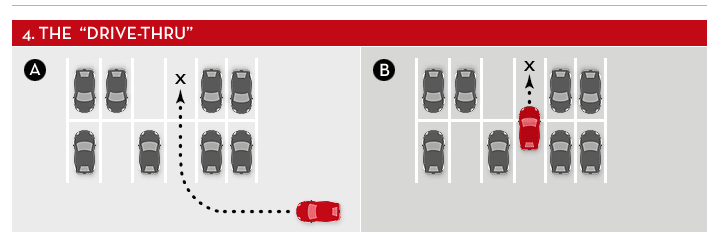
Definitely much more fun than obsessing over "generally accepted accounting principles" in financial and managerial accounting class or understanding PPCs (product possibility curves) in health care economics any day. Though, don't try any of the fancy parking methods at too high of a speed, especially if you don't have health insurance.
Some additional entertaining (/entertainment) news - I'm going to hear Owl City perform live in concert tomorrow night!

Granted, Owl City consists of just one guy (Adam Young) on vocals and, well, everything else (though he occasionally features a female singer, Breanne Duren, on a few of his tracks); and most of the songs have super-artsy lyrics that deal with seemingly nonsensical topics that are generally unheard of in most mainstream music (like dental care) and/or rather conventional topics that are described in unconventional ways ("Cheer up and dry your damp eyes and tell me when it rains/ And I'll blend up that rainbow above you and shoot it through your veins").
But, surprisingly, that's part of what makes his songs so fresh and oddly compelling to listen to.
The real inventiveness in Owl City's music, though, is in its instrumental arrangements - the way that they have the ace ability to envelope you in an amazingly idyllic atmosphere wherever you are and transport you away from the commonplace. And, especially when you've been cooped up in your car during a painfully long commute or you've self-sequestered yourself in the stuffy stacks to study for hours upon hours, isn't that exactly what you want in the music you listen to? Feel free to let your own ears make the choice.
*Props go to the guy who commented on the most recent post in Ramit Sethi's I Will Teach You How To Be Rich blog.
Friday, September 4, 2009
A flu, by any other name, would make us retreat.
H1N1, a.k.a. the "swine" flu, is really nothing to freak out about. Just wash your hands, quit picking your nose so much, and keep your distance from others, especially if they're sick. And if you do have a fever or start feeling ill, skip the crazy Labor Day raves this weekend and stay at home instead, because the surest way to recovery is resting more and drinking lots of fluids. Seriously, what's new?

(And if, for some reason, you don't agree with my advice, hopefully you'll at least believe the CDC's credible health information.)
Whether you're staying in because a) you're already sick, b) you don't want to get sick, or c) you're somewhat of a social recluse and you actually read my blog, here are a few of my most-recent favorite things and a couple reading recs that might keep you occupied for the time being:
Boyce Avenue
I've been listening to their covers (and original songs) for almost two years, but I'm sure there are still tons of people who have never heard of them before. They're pretty mainstream as far as music goes, but that doesn't mean they're any less talented or entertaining than most popular artists on the charts right now.
Chipotle Hummus with Sundried Tomatoes
Unless you're allergic to chickpeas (sorry, friend), there's something terribly wrong with your taste buds if you don't appreciate the amazing flavors in this recipe.
2 lengthy but insightful and well-written articles on patient care in the American health care system:

One lazy autumn afternoon, when you're semi-stealthily siphoning free Wi-Fi from a local coffee establishment and you happen to have some free time on your hands, start reading one of these articles. You'll not only be able to maintain a semblance of intellect & academic superiority, but you might also learn something that's new, interesting, and useful - a critical reader's trifecta.
In other, more personal news, I officially received my college degree about a week ago. I walked across campus in the sticky summer heat and picked up my diploma from the cramped registrar's office. Sadly, it was anti-climactic - no enthusiastic applause, cheering crowds, or pomp and circumstance of any sort, for that matter. At least my name was spelled correctly, though, and the lady behind the desk gave me a 3-second smile and a lukewarm "Congratulations on graduating." Not like it cost me $120,000 and 4 years of my life or anything...
Post-script/Update: If reading pages upon pages isn't your cup of tea, here's a documentary that Bill Moyers recently featured, based on Maggie Mahar's book, Money Driven Medicine: The Real Reason Health Care Costs So Much. Granted, one of my grad school professors showed a clip from it in class so it's not nearly as edge-y or controversial as Michael Moore's Sick-O, but it still does the trick and manages to hold a viewer's attention.
(And if, for some reason, you don't agree with my advice, hopefully you'll at least believe the CDC's credible health information.)
Whether you're staying in because a) you're already sick, b) you don't want to get sick, or c) you're somewhat of a social recluse and you actually read my blog, here are a few of my most-recent favorite things and a couple reading recs that might keep you occupied for the time being:
Boyce Avenue
I've been listening to their covers (and original songs) for almost two years, but I'm sure there are still tons of people who have never heard of them before. They're pretty mainstream as far as music goes, but that doesn't mean they're any less talented or entertaining than most popular artists on the charts right now.
- My favorite cover/acoustic medley of theirs (doesn't have the most views on YouTube, but I like it best, nonetheless)
- An original of theirs, Change Your Mind.
Chipotle Hummus with Sundried Tomatoes
Unless you're allergic to chickpeas (sorry, friend), there's something terribly wrong with your taste buds if you don't appreciate the amazing flavors in this recipe.
2 lengthy but insightful and well-written articles on patient care in the American health care system:

One lazy autumn afternoon, when you're semi-stealthily siphoning free Wi-Fi from a local coffee establishment and you happen to have some free time on your hands, start reading one of these articles. You'll not only be able to maintain a semblance of intellect & academic superiority, but you might also learn something that's new, interesting, and useful - a critical reader's trifecta.
- "How American Health Care Killed My Father" (David Goldhill, The Atlantic, Sept. 2009)
- "The Checklist" (Atul Gawande, The New Yorker, December 2007 - not as recent, but still worth the read)
In other, more personal news, I officially received my college degree about a week ago. I walked across campus in the sticky summer heat and picked up my diploma from the cramped registrar's office. Sadly, it was anti-climactic - no enthusiastic applause, cheering crowds, or pomp and circumstance of any sort, for that matter. At least my name was spelled correctly, though, and the lady behind the desk gave me a 3-second smile and a lukewarm "Congratulations on graduating." Not like it cost me $120,000 and 4 years of my life or anything...
Post-script/Update: If reading pages upon pages isn't your cup of tea, here's a documentary that Bill Moyers recently featured, based on Maggie Mahar's book, Money Driven Medicine: The Real Reason Health Care Costs So Much. Granted, one of my grad school professors showed a clip from it in class so it's not nearly as edge-y or controversial as Michael Moore's Sick-O, but it still does the trick and manages to hold a viewer's attention.
Sunday, August 30, 2009
"It twists people like pretzels."*
Though my classes don't start till Monday, I was reading an assigned article on healthcare reform earlier last week and it got me thinking about two things. 1) How, fortunately - for my parents and professors - and unfortunately - for me - I still do most of my homework ahead of time; and 2) how, contrary to popular belief, there's no single silver bullet to solve all the healthcare woes in America.
Like most everyone else, I've known for a long time that the American healthcare system is confusing, inefficient, and expensive for both physicians and patients alike; actually, that's one of the main reasons I decided to go to public health school before applying to med school. But, what I didn't understand until now is how most of the current healthcare "plans" that various groups have been proposing also have the potential to be just as confusing, inefficient, and expensive if a) there's too much opposition/resistance from the public, and b) if there's too much opposition/resistance from the private (health insurance) sector.
It's been said before, and it's worth saying again: if it's broken and it needs fixing, stop arguing about what needs to be done and start working together to repair it. Yes, it's important to analyze the deficiencies and pitfalls of the American medical system, but it means nothing if no one is willing to compromise on solutions for those problems. It's one thing to say "we can change" but it's another to actually change.
 Sometimes I get bored and make semi-creative t-shirt designs for health care competitions sponsored by Rock The Vote. And then, I post one of those said designs on my blog so people will vote for it if/when it gets chosen as a Top 5 t-shirt design on Sept. 1.
*Quote from Nicholas Kristof's latest NY Times Op-Ed on healthcare, "Until Medical Bills Do Us Part"
Like most everyone else, I've known for a long time that the American healthcare system is confusing, inefficient, and expensive for both physicians and patients alike; actually, that's one of the main reasons I decided to go to public health school before applying to med school. But, what I didn't understand until now is how most of the current healthcare "plans" that various groups have been proposing also have the potential to be just as confusing, inefficient, and expensive if a) there's too much opposition/resistance from the public, and b) if there's too much opposition/resistance from the private (health insurance) sector.
It's been said before, and it's worth saying again: if it's broken and it needs fixing, stop arguing about what needs to be done and start working together to repair it. Yes, it's important to analyze the deficiencies and pitfalls of the American medical system, but it means nothing if no one is willing to compromise on solutions for those problems. It's one thing to say "we can change" but it's another to actually change.
 Sometimes I get bored and make semi-creative t-shirt designs for health care competitions sponsored by Rock The Vote. And then, I post one of those said designs on my blog so people will vote for it if/when it gets chosen as a Top 5 t-shirt design on Sept. 1.
Monday, August 24, 2009
Money can't buy happiness, but it can buy a lot of other cool stuff.
(See update at the end.)
Between bi-monthly recaps of the Daily Show, daily readings of the most popular articles in the NY Times, and keeping up with random blog updates on a week-to-week basis, I've actually managed to be relatively productive these past few days, and not just at my desk (although, it is nice and I did assemble it all by myself).
 My $24.99 desk from Wal-Mart
It's not just my time that I've learned to budget more carefully, though - I've begun to find better ways to budget my money, too. And I feel the least I can do is pass the insight onto everyone else.
It all started a few weeks ago, when I started reading up on all the Money-Saving Tips that U.S. World & News Report compiled months, if not years, ago. Now that I have more expenses, less disposable income, and more reasons to save, I figured it wouldn't hurt to do some financial research.
Then came a brilliant encounter with P&G eSaver, an amazingly sustainable way to download coupons onto your grocery store card. I've always pictured coupon-clippers as frugal, stay-at-home supermoms or retired elderly couples who spend their days gardening and playing bridge, but now I've found a way to maintain my street cred and save a few bucks every time I go shopping, simply by the click of my mouse.
 P&G eSaver (a.k.a., my new favorite financial find)
Tonight, though, was the icing on the money cake. I ended up reading an old article in the NY Times - partly by happenstance and partly by my conscious decision to read articles in the "Your Money" column - "Financial Advice for Recent Graduates". What caught my attention was not so much the words of wisdom that the advice-givers spewed in response to the specific questions about financial planning, but the fact that one of the advisors, 26-year-old Ramit Sethi, had a blog called I Will Teach You To Be Rich. I mean, what kind of person would not want to read a blog with that kind of name?
Apparently, his blog gets about 250,000 unique readers a month, so there's a pretty good possibility that I'm one of the last twenty-somethings in America to find out about it - but that doesn't mean I'm any less excited to stock up on all the financial tips that the site has to offer (even if I am about a year or so late). It's definitely earned a permanent spot on my Blogger Reading List.
Best quote of the NY Times article? Ramit Sethi's one-liner: Rich people plan for things before they need them, while others are caught treading water when something bad happens. Not sure if that's exactly true, given that I know a lot of rich people who don't know the first thing about financial planning (or life-planning, in general) - but it got me thinking that maybe, those who plan properly simply have a much better chance at becoming rich. Perhaps, careful planning begets financial success, and that, in turn, is the positive reinforcement that propels an individual to continue their conscientious behaviors.
Time to turn my thermostat up three degrees and save $10 this month! (Check out the "Power fiction & facts" list by clicking on the thermostat link - who knew a gas and electric company could be simultaneously informative and witty?)
Update: To be completely honest, the two aforementioned tips in this post (using P&G eSaver once every month or so and turning my thermostat/AC up a few degrees) are actually the only two changes I'm making to be more prudent with my money. Not that this is anything novel, but I'd like to think that small changes make big differences (kind of like with this UK public health program I read about after seeing the Michael Moore documentary, SiCKO). Not to mention, Malcolm Gladwell completely agrees with me, so that has to mean something. (The Tipping Point is what enlightened me during countless rides on the métro and solo meals in cafés when I was in Paris this summer - I highly recommend reading it, if you haven't already).
Between bi-monthly recaps of the Daily Show, daily readings of the most popular articles in the NY Times, and keeping up with random blog updates on a week-to-week basis, I've actually managed to be relatively productive these past few days, and not just at my desk (although, it is nice and I did assemble it all by myself).
My $24.99 desk from Wal-MartIt's not just my time that I've learned to budget more carefully, though - I've begun to find better ways to budget my money, too. And I feel the least I can do is pass the insight onto everyone else.
It all started a few weeks ago, when I started reading up on all the Money-Saving Tips that U.S. World & News Report compiled months, if not years, ago. Now that I have more expenses, less disposable income, and more reasons to save, I figured it wouldn't hurt to do some financial research.
Then came a brilliant encounter with P&G eSaver, an amazingly sustainable way to download coupons onto your grocery store card. I've always pictured coupon-clippers as frugal, stay-at-home supermoms or retired elderly couples who spend their days gardening and playing bridge, but now I've found a way to maintain my street cred and save a few bucks every time I go shopping, simply by the click of my mouse.
P&G eSaver (a.k.a., my new favorite financial find)Apparently, his blog gets about 250,000 unique readers a month, so there's a pretty good possibility that I'm one of the last twenty-somethings in America to find out about it - but that doesn't mean I'm any less excited to stock up on all the financial tips that the site has to offer (even if I am about a year or so late). It's definitely earned a permanent spot on my Blogger Reading List.
Best quote of the NY Times article? Ramit Sethi's one-liner: Rich people plan for things before they need them, while others are caught treading water when something bad happens. Not sure if that's exactly true, given that I know a lot of rich people who don't know the first thing about financial planning (or life-planning, in general) - but it got me thinking that maybe, those who plan properly simply have a much better chance at becoming rich. Perhaps, careful planning begets financial success, and that, in turn, is the positive reinforcement that propels an individual to continue their conscientious behaviors.
Time to turn my thermostat up three degrees and save $10 this month! (Check out the "Power fiction & facts" list by clicking on the thermostat link - who knew a gas and electric company could be simultaneously informative and witty?)
Update: To be completely honest, the two aforementioned tips in this post (using P&G eSaver once every month or so and turning my thermostat/AC up a few degrees) are actually the only two changes I'm making to be more prudent with my money. Not that this is anything novel, but I'd like to think that small changes make big differences (kind of like with this UK public health program I read about after seeing the Michael Moore documentary, SiCKO). Not to mention, Malcolm Gladwell completely agrees with me, so that has to mean something. (The Tipping Point is what enlightened me during countless rides on the métro and solo meals in cafés when I was in Paris this summer - I highly recommend reading it, if you haven't already).
Wednesday, August 12, 2009
I fall asleep in hospital parking lots.*
For the next two weeks or so, I'll be floating on the virtual corner of health care reform and health care debates, and physically residing near the corner of the public health school and the health sciences library.
Also, I'll most likely be using the word "health" at least once in every written sentence.
 A snapshot of my daily "commute" (i.e., my walk across the street).
Lastly, just for clarification's sake, I don't actually fall asleep in hospital parking lots - but a lot of med students and residents do fall asleep on the exceedingly comfortable leather couches in the health sciences library.
Looking forward to health-related raucousness, pedestrian travel, and, if I'm lucky, well-deserved naps on the library couches in the near future. Read me on the flip side.

Also, I'll most likely be using the word "health" at least once in every written sentence.
 A snapshot of my daily "commute" (i.e., my walk across the street).
Looking forward to health-related raucousness, pedestrian travel, and, if I'm lucky, well-deserved naps on the library couches in the near future. Read me on the flip side.
Monday, July 13, 2009
Reverse cultural shock.
Five or so weeks in Paris can completely change your outlook on life in the States - like I wrote once before, the real cultural shock hits after you get home from a foreign country. The following are observations in point:
Paris is a city where...
... people spend more hours on the important things in life: eating and enjoying their meals with friends, relaxing in parks and at neighborhood cafés, and walking instead of driving to purchase warm baguettes and pains au chocolat that are baked fresh daily from the local boulangerie.
Atlanta is a city where...
... people waste a lot of hours on unimportant things and then rush through the rest of life: speeding through the drive-thru of fast-food establishments, grabbing artificially-sweet-calorie-filled custard danishes and cups of coffee to go, and then sitting in traffic while commuting to work in their cars.
Paris is a city where...
... if you're a woman and you exist, men hit on you on every street corner, metro stop, café, store front, etc., etc... and sometimes keep following you for blocks, until they get a chance to hit on you.
Atlanta is a city where...
...if you're a woman and you dress provocatively in public, men glance over but don't say anything at all, because saying something remotely offensive might constitute a sexual harassment lawsuit.
The three things that I miss most about Paris:
 The métro
 The food
Paris is a city where...
... people spend more hours on the important things in life: eating and enjoying their meals with friends, relaxing in parks and at neighborhood cafés, and walking instead of driving to purchase warm baguettes and pains au chocolat that are baked fresh daily from the local boulangerie.
Atlanta is a city where...
... people waste a lot of hours on unimportant things and then rush through the rest of life: speeding through the drive-thru of fast-food establishments, grabbing artificially-sweet-calorie-filled custard danishes and cups of coffee to go, and then sitting in traffic while commuting to work in their cars.
Paris is a city where...
... if you're a woman and you exist, men hit on you on every street corner, metro stop, café, store front, etc., etc... and sometimes keep following you for blocks, until they get a chance to hit on you.
Atlanta is a city where...
...if you're a woman and you dress provocatively in public, men glance over but don't say anything at all, because saying something remotely offensive might constitute a sexual harassment lawsuit.
The three things that I miss most about Paris:
 The métro
Despite its initially claustrophobic-inducing qualities, its lack of air conditioning, and its gritty-watch-where-you're-sitting atmosphere, it's an unbelievably efficient and all-around relaxing commute once you get the hang of things. Even at its most crowded, sardine-packed times, you get the sense that you're only truly Parisian if you can handle the everyday idiosyncrasies of the métro to navigate your way through the city.
 The food
Simply put, it's fresh, it's French, and it's fantastic. Every meal I had seemed like the best meal I'd ever had - above is a picture of the amazing four-cheese pasta we had at a restaurant that we stumbled upon during our escapades in Montmartre.


The weather
Compared to the sweltering summer heat and humidity of Atlanta, summer in Paris was a haven of temperate afternoons and relatively cool evenings. Although the weather patterns were somewhat unpredictable and the rainstorms were often unexpected, at least the sun never burnt you to a crisp the moment you walked outside.
Paris isn't perpetually perfect, and Atlanta isn't absolutely abominable, but it'll just take awhile longer for me to really adjust to being back. Though, I think my Parisian perspectives on most of the aforementioned things will always influence my decisions here in the States.

In other miscellaneous news, Dr. Pauline Chen's latest article in the NY Times ("When Doctors Make Mistakes") propelled me to start researching public health practicums that focus on physician-in-training and patient outcomes. I remember reading her book, Final Exam, when it first came out about two years ago - it was incredibly honest and well-written, and I definitely recommend it to anyone who's considering medical school or any reader who just wants to better understand patient care from the physician perspective.
Paris isn't perpetually perfect, and Atlanta isn't absolutely abominable, but it'll just take awhile longer for me to really adjust to being back. Though, I think my Parisian perspectives on most of the aforementioned things will always influence my decisions here in the States.

In other miscellaneous news, Dr. Pauline Chen's latest article in the NY Times ("When Doctors Make Mistakes") propelled me to start researching public health practicums that focus on physician-in-training and patient outcomes. I remember reading her book, Final Exam, when it first came out about two years ago - it was incredibly honest and well-written, and I definitely recommend it to anyone who's considering medical school or any reader who just wants to better understand patient care from the physician perspective.
Subscribe to:
Posts (Atom)


